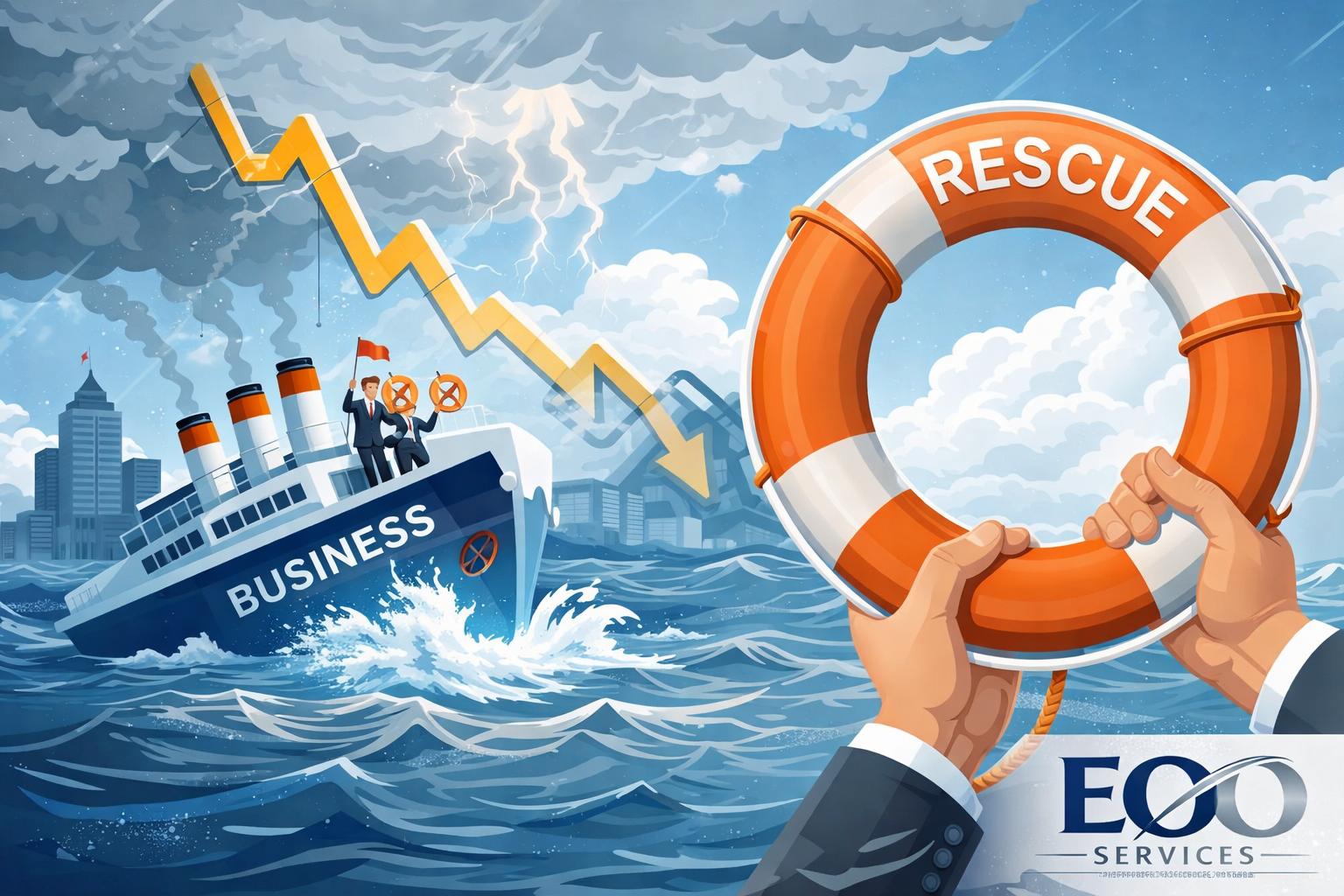
Business rescue is a legal process designed to give a financially distressed company a structured opportunity to survive, rather than collapse into liquidation. In simple terms, it is a formal mechanism that allows a business that is struggling to pay its debts, manage cash flow, or operate sustainably to pause, stabilise, and restructure under supervision.
At its core, business rescue recognises that many companies fail not because they are fundamentally unviable, but because they are temporarily overwhelmed by debt, poor cash flow, governance failures, or external shocks. Instead of allowing value to be destroyed through liquidation, the law provides a controlled environment in which the business can be rehabilitated.
So, what does business rescue actually involve?
Once a company enters business rescue, an independent business rescue practitioner is appointed to oversee the company’s affairs. Management does not disappear, but their powers are restricted and subject to oversight. Creditors are temporarily prevented from enforcing claims, giving the business breathing room. During this period, a rescue plan is developed, setting out how the business will be restructured, how creditors will be dealt with, and whether the company can continue trading in some form.
Why is business rescue needed?
Without business rescue, the alternative for most distressed companies is liquidation. Liquidation focuses on shutting the business down and selling its assets, often at distressed values, to pay creditors. This usually results in job losses, reduced recoveries for creditors, and the permanent loss of a functioning enterprise.
Business rescue aims to change that outcome. It is needed where there is still underlying value in the business — whether in its operations, contracts, brand, or workforce — but that value is at risk due to financial or operational distress. By intervening early, business rescue can preserve jobs, improve creditor recoveries, and restore the company to a sustainable footing.
What are the consequences of entering business rescue?
Entering business rescue is a serious step and it does carry consequences. The company is publicly flagged as being under business rescue, which can affect reputation and trading relationships. Directors’ powers are curtailed, and decisions are subject to oversight. Contracts may be renegotiated or compromised, and creditors may not be paid in full or on original terms.
However, these consequences must be weighed against the alternative. In most cases, liquidation produces harsher and more permanent outcomes. Business rescue is not about avoiding responsibility; it is about managing failure in a controlled, value-preserving way.
What are the possible outcomes of business rescue?
Business rescue does not have a single outcome. Broadly, there are three realistic possibilities.
First, the company is successfully rehabilitated and continues trading in a restructured form. This may involve new funding, reduced debt, operational changes, or a revised business model.
Second, the business may be partially rescued. Certain divisions, assets, or operations are preserved or sold as a going concern, while others are closed. This still often produces a better result for creditors and employees than liquidation.
Third, if rescue is not feasible, the process may transition into liquidation. Even in this scenario, business rescue can still add value by ensuring an orderly process and improved recoveries compared to an immediate collapse.
Is business rescue a sign of failure?
Business rescue is often misunderstood as an admission of defeat. In reality, it is a recognition of commercial reality and a decision to act decisively. Many successful restructurings begin with acknowledging that the existing structure is no longer working. Early intervention is frequently the difference between recovery and collapse.
In simple terms, business rescue is about control, oversight, and structured recovery. It is a tool designed to give distressed businesses a second chance where that chance still makes commercial sense.